
Beyond 'Lowest Cost Wins': How Australia Can Build More Ethical, Sustainable Supply Chains
By Miranda Jacobson
Australian supply chains shape what households buy, how workers are treated, how much waste enters landfill, and how resilient local businesses are when global shocks hit. For decades, many purchasing decisions were judged by a narrow question: who can deliver the cheapest product, fastest? That logic helped lower prices, but it also hid costs in places consumers rarely see: underpaid labour, fragile offshore sourcing, excessive packaging materials used throughout the supply chain, long freight routes, and environmental damage carried by communities far from the checkout.
1. The big picture
Ethical and sustainable supply chains are not built by slogans. They are built by traceability, fair contracts, measurable environmental reductions, and proof that workers and communities are not carrying hidden costs. For Australian businesses, the practical shift is from “what is cheapest today?” to “what will still be responsible, available, and defensible five years from now?” That means valuing durability, supplier relationships, repairability, packaging recovery, labour standards, emissions reduction, and honest reporting.
2. What a sustainable supply chain looks like in practice
A genuinely sustainable supply chain is visible from source to shelf. A retailer, manufacturer, builder, food company, or logistics operator should be able to explain where key materials come from, who handles them, how they are transported, what waste is created, and what happens when the product or packaging reaches the end of its useful life.
In Australia, large entities with annual consolidated revenue of at least $100 million must report under the Commonwealth Modern Slavery Act 2018 on how they assess and address modern slavery risks in their operations and supply chains. The law is a transparency framework, not a complete guarantee of ethical sourcing, but it has made supply chain risk a boardroom issue rather than a back-office detail. A responsible supply chain usually includes:
● clear supplier mapping beyond first-tier contractors
● fair labour expectations written into contracts and checked in practice
● packaging designed for reduction, reuse, recycling, or composting where appropriate
● transport choices that reduce unnecessary weight, distance, empty space, and repeat handling
● environmental claims backed by evidence rather than vague branding
● accountability when standards are breached, including remediation for affected workers
The hard part is not writing these values down. The hard part is making them operational when cheaper shortcuts are available.
3. Packaging, Freight, and Load Security
Some of the most meaningful supply chain improvements are not glamorous. They happen in warehouses, loading docks, procurement spreadsheets, pallet configurations, and packaging specifications. One quietly significant logistics choice is how palletised goods are secured for transit. Many operations still rely on steel strapping for heavy loads because of its strength, but steel bands are single-use, prone to rust, and can snap under tension, a real safety risk on loading docks handling thousands of pallets a year.
Composite strapping is gaining ground as a practical alternative because it offers comparable tensile strength for heavy, palletised loads while being lighter and safer to handle, and, unlike steel, it can be reused across multiple trips instead of thrown out after one. It is a small operational decision, but small decisions multiplied across thousands of shipments can support a broader move away from disposable convenience and toward long-term thinking.
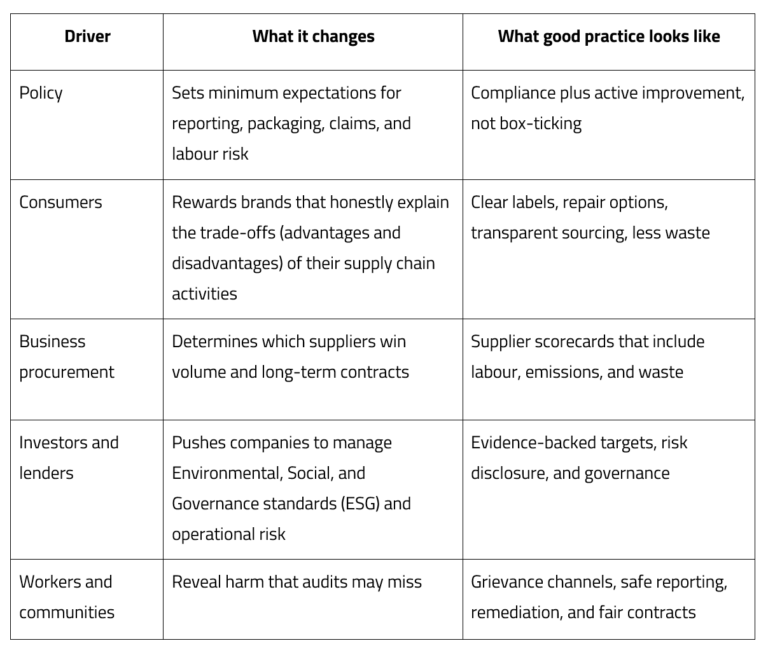
The table below sets out how stakeholders may pressure an organisation to improve its supply chain.
5. From shelf appeal to source accountability
The old model rewarded distance. If a product looked good on the shelf and landed at the lowest price, the upstream story often stayed invisible. The new model rewards explainability. That matters because supply chains are rarely simple. A cotton shirt may involve farms, ginners, textile mills, dye houses, factories, freight providers, ports, warehouses, and retailers. A packaged food item may involve farms, processors, packaging converters, cold storage, distribution centres, and supermarkets. Each link can either improve or weaken the ethical position of the final product.
Accountability means asking better questions before orders are placed. Are suppliers paid in a way that allows legal wages and safe work? Can the business verify high-risk inputs? Are environmental impacts being reduced at source, or simply offset or rebranded? Does the company have a process for complaints, audits, corrective action, and public reporting? The Australian Anti-Slavery Commissioner has recently recommended stronger modern slavery laws, including reforms intended to move beyond basic reporting and drive more consistent risk-based action by large Australian entities.
6. Why Marketing Claims Are Not Enough
Australians are increasingly alert to greenwashing. A claim such as “eco-friendly”, “sustainable”, or “carbon neutral” can be misleading if it is vague, selective, or unsupported. The ACCC’s guidance for businesses says environmental and sustainability claims should be clear, accurate, and trustworthy, and it explains how the Australian Consumer Law applies to such claims.
This matters for supply chains because the public usually sees the claim, not the chain. A brand may advertise recycled packaging while ignoring freight emissions, or promote ethical sourcing while lacking visibility beyond its first-tier supplier. A credible business should be able to show the boundary of the claim: what is covered, what is not, what evidence supports it, and what remains unresolved.
7. A Useful Resource for Better Packaging Decisions
For businesses reviewing packaging choices, the Australian Packaging Covenant Organisation’s Sustainable Packaging Guidelines are a useful starting point. APCO is the peak industry body for Australia’s packaging sector and administers the Australian Packaging Covenant, which is part of Australia’s co-regulatory packaging arrangement. The guidelines help businesses think beyond appearance and cost by considering packaging design, material selection, recovery pathways, and circular economy outcomes. They are especially useful for teams that need a practical framework rather than a broad sustainability slogan. A procurement, operations, or product team can use the guidance to compare packaging options before a new product is launched, not after waste problems are already locked in.
8. FAQ
What is the biggest barrier to ethical supply chains in Australia?
The biggest barrier is often poor visibility. Many businesses know their direct suppliers but have limited insight into subcontractors, raw material sources, labour brokers, and logistics partners deeper in the chain.
Are sustainable supply chains always more expensive?
Not always. Some improvements, such as reducing packaging volume, consolidating freight, preventing product damage, and improving supplier reliability, can reduce long-term costs. Others may cost more upfront but lower risk and improve resilience.
What can consumers realistically do?
Consumers can support companies that provide specific evidence, avoid vague green claims, buy durable goods, reduce returns, and ask brands where products are made and how workers are protected. But the largest changes usually come from business procurement and policy.
What should businesses stop doing first?
They should stop treating sustainability as a marketing layer added after sourcing decisions are made. Ethical and environmental standards need to be built into product design, supplier selection, shipping methods, contracts, and reporting.
9. Conclusion
the only measure of value. The better model is one that prices in worker wellbeing, environmental impact, resilience, transparency, and long-term
usefulness. Policy can set the floor, consumers can shift demand, and businesses can change the system through everyday procurement and logistics
decisions. The future supply chain is not just cheaper to run; it is harder to exploit, easier to verify, and better built to last.